


FAQs - Frequently asked questions

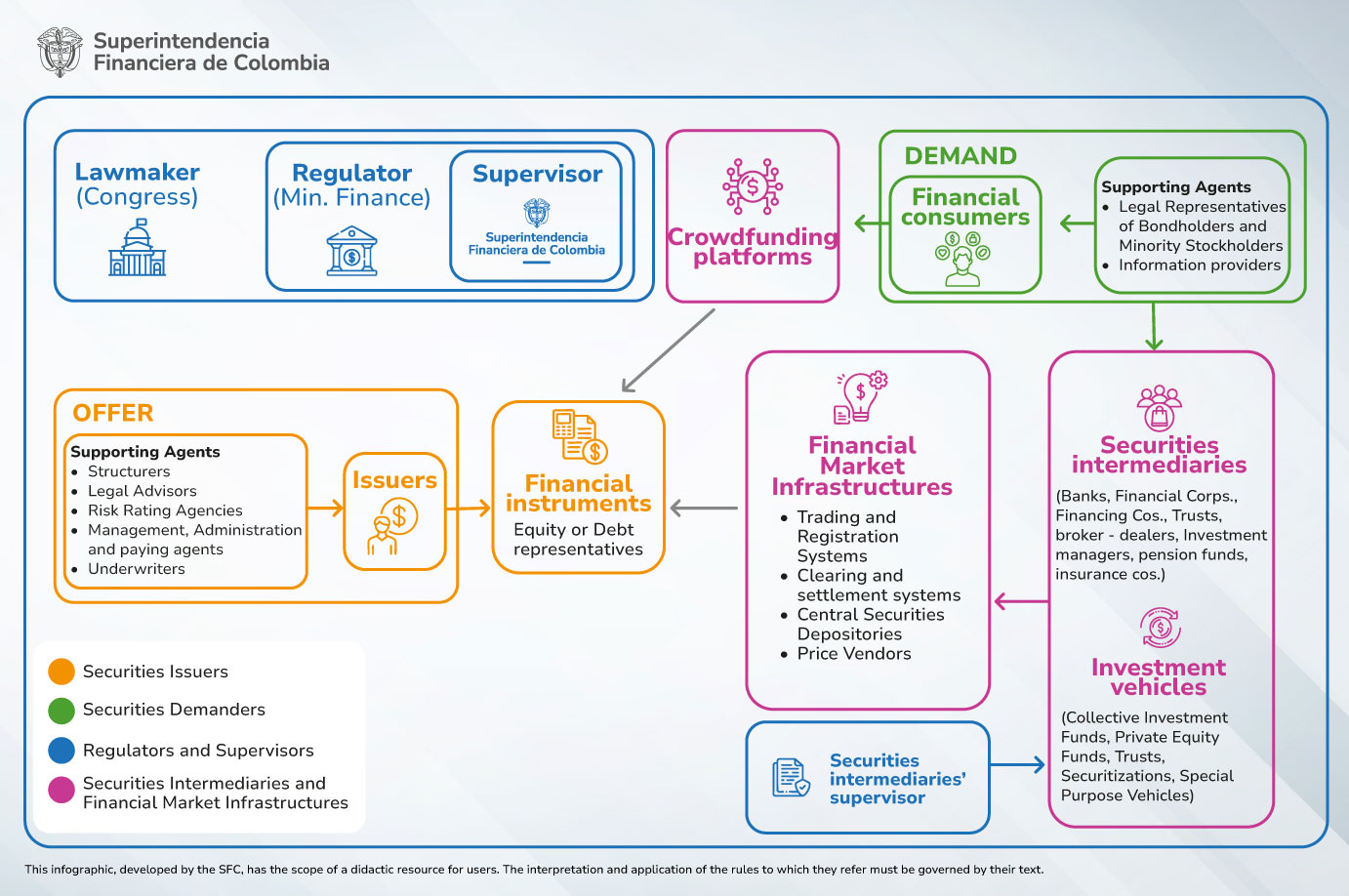
Questions regarding Market Structure
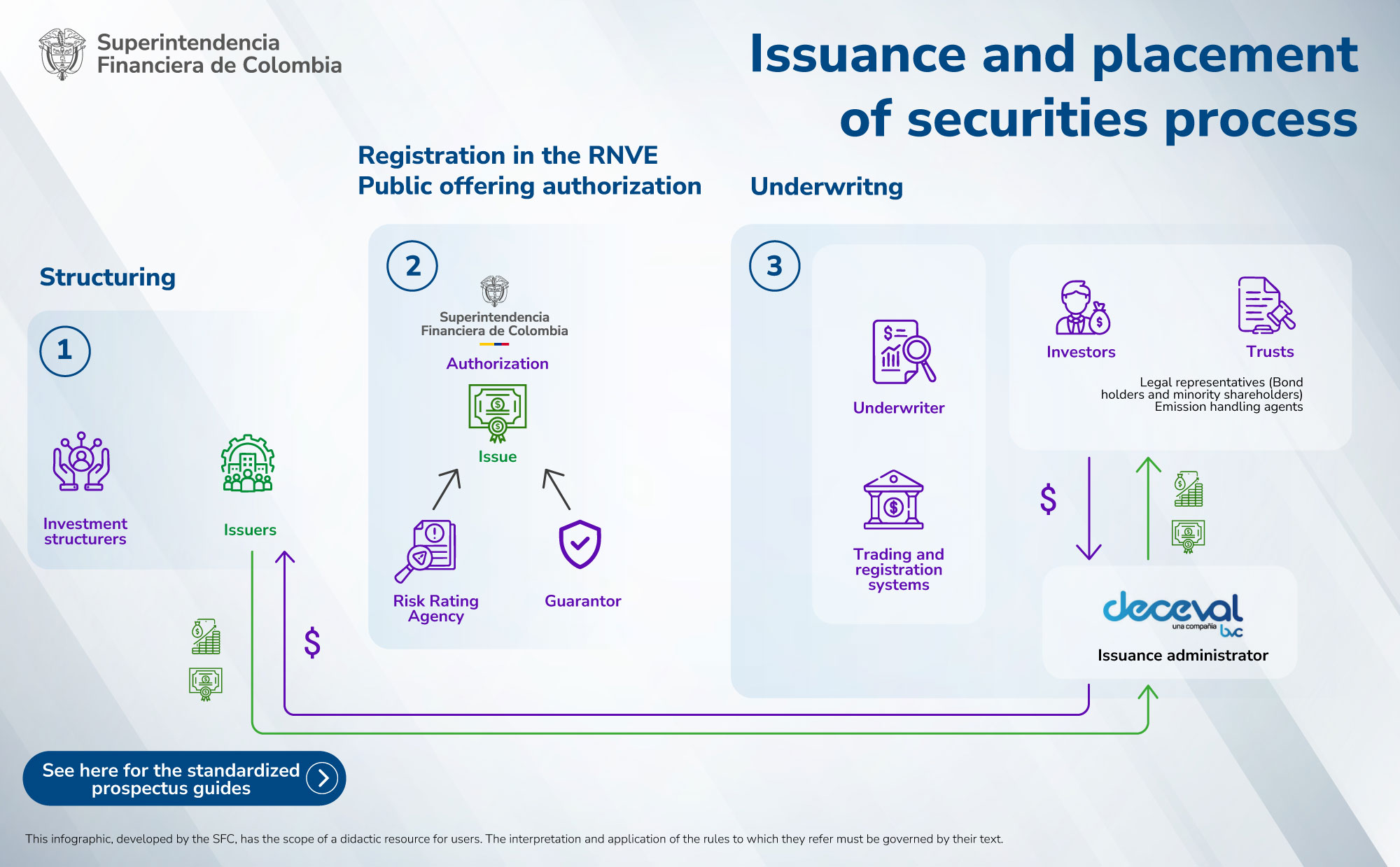
Questions regarding the Issuance Process
In accordance with Article 5.2.1.1.2 of Decree No. 2555 of 2010 (Legal nature of the entities issuing securities), the following may be issuers of securities:
- The stock corporations;
- Limited liability companies;
- Cooperative entities;
- Non-profit entities;
- The Nation and public entities decentralized by services and territorially;
- Foreign governments and foreign public entities;
- Multilateral credit organizations;
- Foreign entities;
- Branches of foreign companies;
- Autonomous trust funds, whether or not constituted as collective investment funds;
- Collective investment funds whose legal regime authorizes them to issue securities;
- The universalities referred to in Law 546 of 1999.
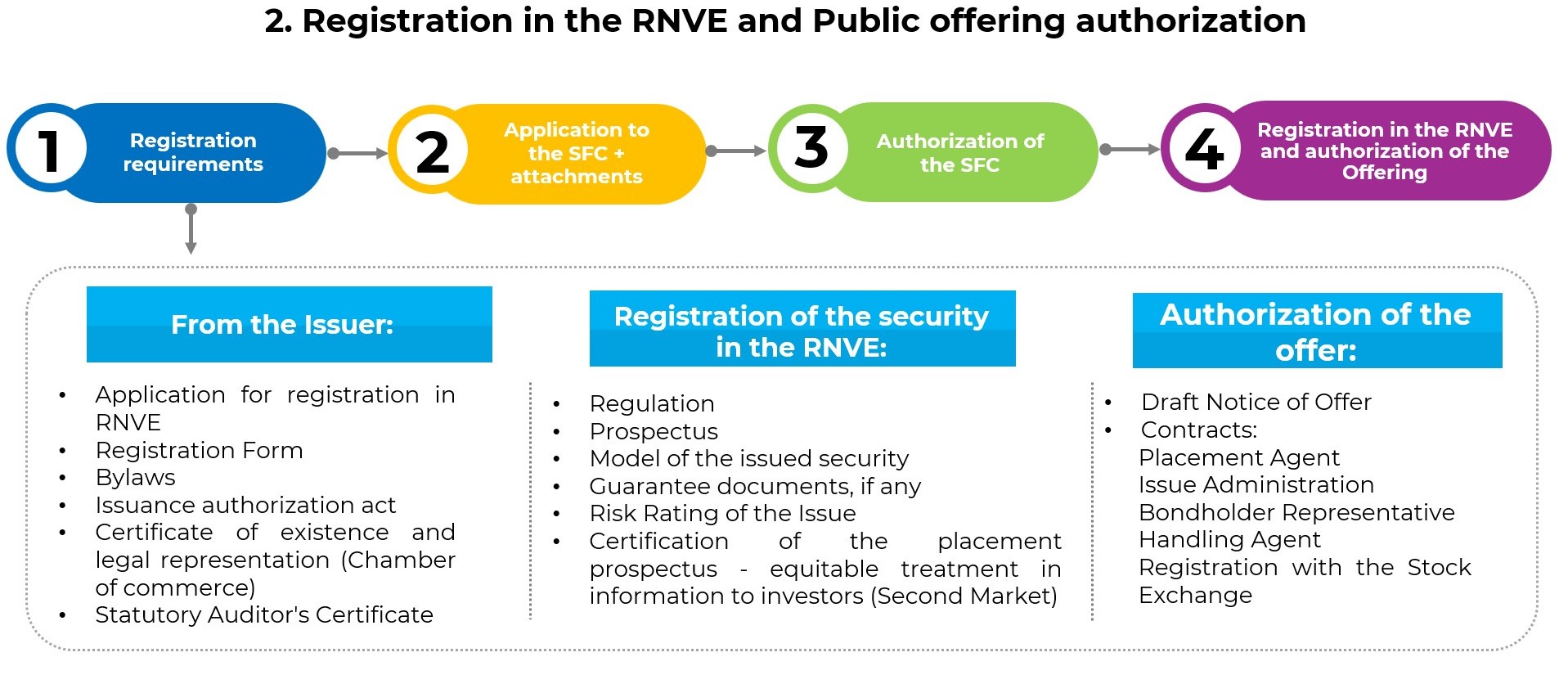
- To be able to make a public offering of the registered securities or that they can be traded in a trading system.
- The duty to maintain the integrity and transparency of the securities market.
- Supervision as issuer by the SFC in degree of Control (Exclusive - Concurrent). Obligation to periodically update financial and legal information, as well as publish relevant information.
The registration does NOT imply any qualification or responsibility on the part of the SFC, about the registered legal entities or about the price, the goodness or negotiability of the security or of the respective issue, or about the solvency of the issuer.
- Surveillance (Comprehensive Supervision): Permanent surveillance involves oversight of both the organizational structure of a legal entity—such as its formation and operation—and the development of the activities it has been authorized to perform. According to Article 11.2.1.6.1 of Decree 2555 of 2010, the SFC is responsible for inspection and surveillance of the entities and activities listed in paragraph three, numeral one, of Article 75 of Law 964 of 2005.
- Control: The control exercised by the SFC is a different level of supervision from inspection and surveillance. It does not involve authority over the formation, operation, or development of the corporate purpose of the entity. Instead, it focuses more on protecting investors participating in the securities market through information disclosure. This control applies to securities issuers, defined as “…entities that have securities registered in the National Registry of Securities and Issuers (RNVE).” (See Article 11.2.1.6.2 of Decree 2555 of 2010.)
Within this control framework, it is important to distinguish between:
- Exclusive Control: Exclusive control applies to securities issuers whose corporate purpose is not considered of public interest. The SFC is responsible for:
- Concurrent Control: Concurrent control applies to securities issuers whose services or economic activities are deemed of public interest and are therefore subject by law to inspection and surveillance by another state authority. In these cases, the SFC’s control function focuses on:
Questions regarding Taxes
Questions regarding Foreign Exchange
Questions regarding self-regulation
A Self-Regulatory Organization is a private entity authorized to develop and enforce rules for professional conduct in the securities market. The official SRO in Colombia is AMV – Autorregulador del Mercado de Valores de Colombia.
The definition of self-regulation comes from Law 964 of 2005, Article 24, which establishes that it consists of three functions:
1. Normative function – adopting rules to ensure proper conduct in securities intermediation.
2. Supervisory function – verifying compliance with market rules and SRO regulations.
3. Disciplinary function – imposing sanctions for violations.
In addition to these statutory functions, AMV also performs a certification function, ensuring that professionals participating in the securities market demonstrate the technical competence, ethical standards, and specialized knowledge required for the industry.
This certification process strengthens market integrity and promotes higher professional standards among intermediaries.
Law 964 (2005) establishes that all securities intermediaries must self-regulate. This includes broker-dealers, banks, financial corporations, trust companies, pension funds, insurers, and any other entity authorized to intermediate securities.
Self-Regulated Entities: Click here for a complete list of the institutions subject to self-regulation.
Foreign investors benefit from:
1. A dual protection model (SFC + AMV),
2. Strong professional and ethical standards,
3. Rapid disciplinary responses,
4. Transparent rules and uniform enforcement,
5. Enhanced trust in the market’s integrity.
Complaints and Misconduct Reports: Click here for submitting or consulting complaints, claims, or allegations of misconduct.